Blog · Safety vs Security
AI Safety vs AI Security: Intent Is the Key Distinction (2026 Guide)
By Get AI Safety Certified Team, Get AI Safety Certified · September 14, 2026
3 min read · 7 views
Key Takeaways
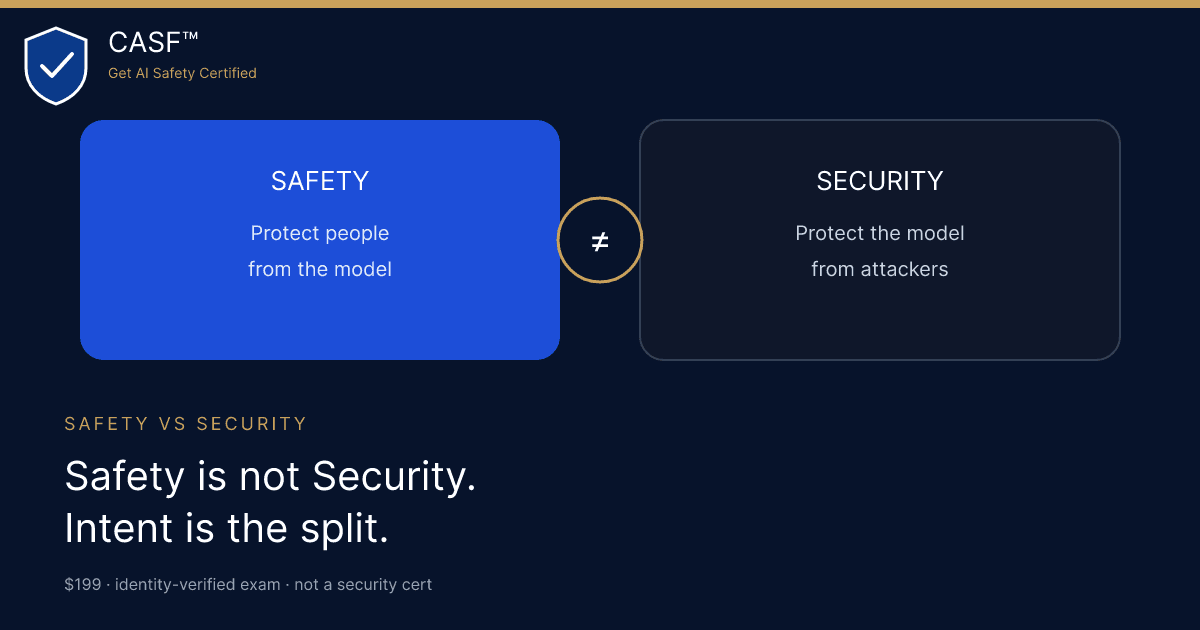
- Safety = protect people from the model (accidental harm: bias, hallucinations, leaking PII, over-reliance) — guardrails. Security = protect the model from attackers (adversarial: prompt injection, breaches, exfiltration). Intent is the key distinction.
TL;DR
Safety is not security. Safety puts guardrails around accidental harm — bias, hallucinations, leaking PII, over-reliance. Security defends the model from attackers — prompt injection, breaches, exfiltration. Most paid certs teach security. Get AI Safety Certified teaches safety for builders.
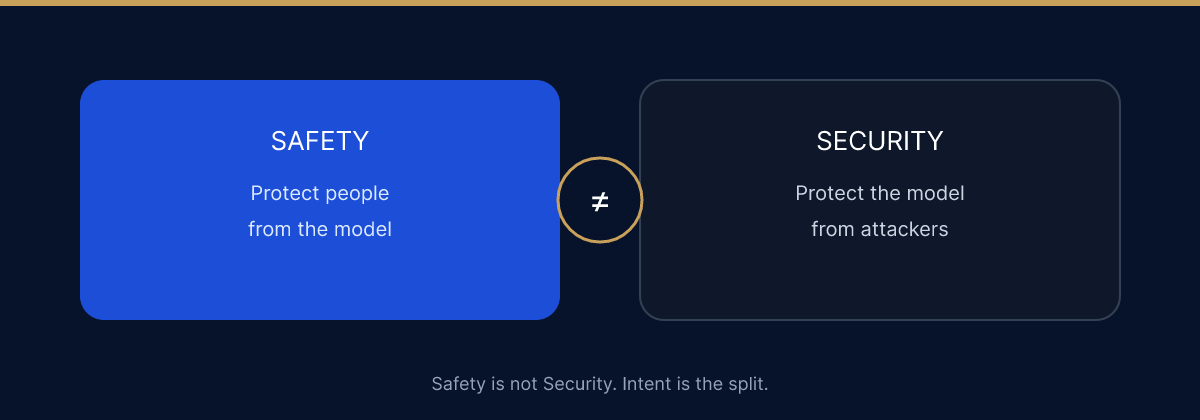
Safety protects people from the model. Security protects the model from attackers.
Key Takeaways
- Safety = protect people from the model (accidental harm: bias, hallucinations, leaking PII, over-reliance) — guardrails. Security = protect the model from attackers (adversarial: prompt injection, breaches, exfiltration). Intent is the key distinction.
- If the harm is accidental, you are in a safety problem. If someone is attacking the system, you are in a security problem.
- TAISE ($795) is a security-governance track for CISOs despite the word Safety in the name. Foundations ($199) is safety for PMs, lawyers, HR, and builders.
What is the difference between safety and security?
Teams buy an “AI safety” course and get a syllabus about prompt injection, DSPM, and Zero Trust. That is security. The product still hallucinates a refund, still pastes a client contract into a chatbot, still treats a fluent answer as a fact. Those failures are safety failures. They do not require a villain. They require a model that did something the organization cannot stand behind.
Intent is the split. Safety work assumes the system is trying to be helpful and still causes harm. Security work assumes someone is trying to make the system fail on purpose. If you mix the two, you staff the wrong people and still have no one-page policy HR will sign.
Accidental harm is a guardrail problem
A support bot invents a bereavement fare. A hiring screen ranks one demographic above another. A RAG assistant quotes a stale policy as current. A junior analyst pastes payroll into a public model because the UI made it easy. None of those start with an attacker. They start with a deployer who put a model in front of customers or staff without a human review path, a disclosure, or a list of what never goes in a prompt.
Guardrails here are operational. You name an owner. You say which uses are allowed. You log enough to reconstruct what the model said. You keep a person in the loop when the output can move money, legal rights, or someone’s job.
Adversarial harm is a security problem
Prompt injection, jailbreaks, model theft, poisoned retrieval corpora, and credential stuffing against an AI admin panel are security. You need access control, monitoring, and people who already speak CISO. Enterprise programs priced for security leaders exist for that track. TAISE lists around $795. CASO sits near $2,199.
If your job is to stop an attacker from owning the model, buy that track. If your job is to stop the model from harming a person, a client, or the company, you are on the safety track.
How to use the distinction on Monday
When an incident lands, ask: did someone attack us, or did the model do something we should have forbidden? If it is an attack, page security. If it is accidental harm, you need the safety owner and the policy clause you already wrote.
Keep the vocabulary honest in job posts. “AI safety certified” should mean you can protect people from the model, write a policy, and pass an identity-verified exam.
Enter the free classroom
Watch Module 0 — Why AI Safety Is Not Security — with no login. Write and quiz stay in your classroom. Unlock M1–M5 for $199. If you are a deployer, also read the EU AI Act deployer page.
Comments
No public comments yet. Yours will show after review.
Get AI Safety Certified — $199
Identity-verified exam, verifiable QR + LinkedIn badge. Start free Module 0.